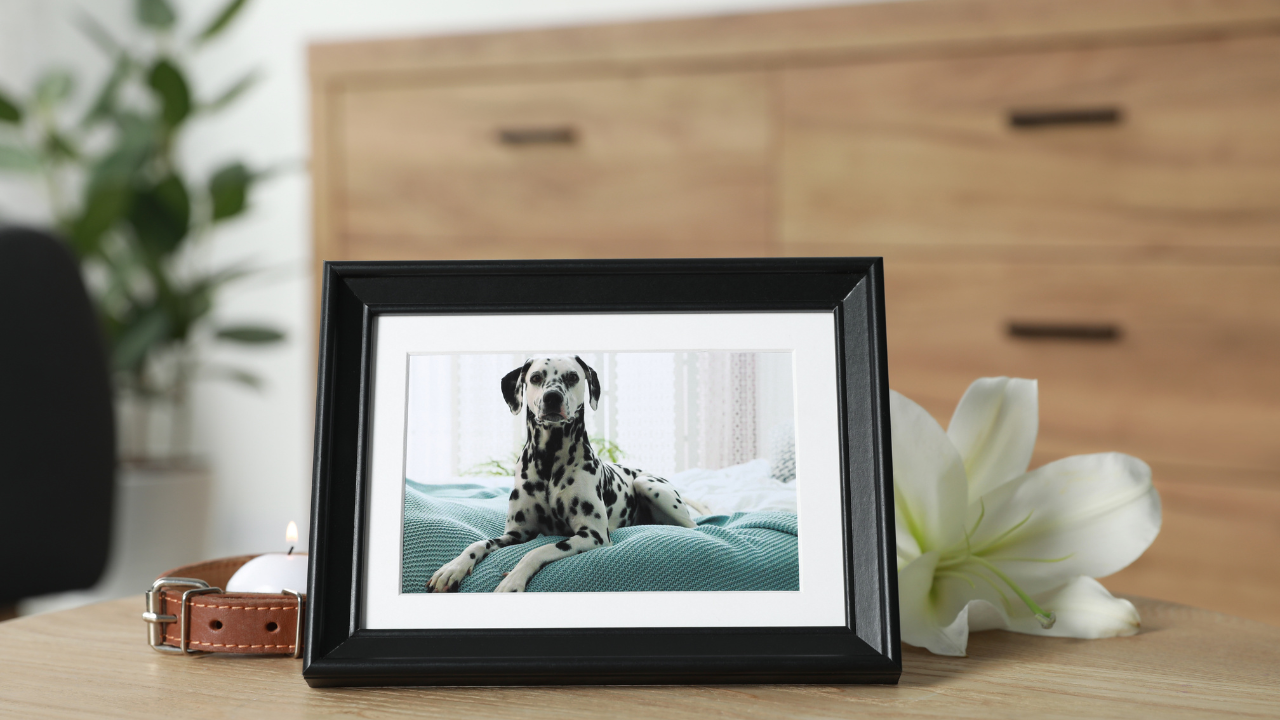
Grieving a Dog Who's Still Here: Understanding Anticipatory Grief
Jun 19, 2026
You're sitting on the floor with your dog's head in your lap, and out of nowhere the tears come — not because anything has happened, but because of what will. The vet's words are still echoing. The diagnosis is real. And even though your dog is right here, breathing, warm, maybe even wagging, you feel like you're already starting to lose them.
If that's where you are, please hear this first: you are not getting ahead of yourself, you are not being morbid, and you are not "wasting" the time you have left. You're experiencing something with a name and a long history in the study of grief. It's called anticipatory grief, and it is one of the most human responses there is.
What anticipatory grief actually is
Most of us think of grief as something that arrives after a loss. But more than eighty years ago, the psychiatrist Erich Lindemann noticed that people often begin to mourn before a death — rehearsing the separation, feeling the sorrow in advance, emotionally preparing for a future they don't want (Lindemann, 1944). He gave this experience a name, and grief researchers have studied it ever since.
For families facing a terminal diagnosis, anticipatory grief tends to show up in two ways at once. There's the sorrow aimed at the future — picturing the empty bed, the leash by the door, the morning walk that won't happen. And there's a quieter grief happening in the present, as you mourn the small losses already arriving: the stamina that's fading, the appetite that's changed, the spark that flickers differently than it used to. Both are real. Both are grief. And feeling them now doesn't mean you love your dog any less — it means you love them enough that the thought of their absence already aches.
Why it can feel so confusing and lonely
Anticipatory grief carries a particular sting that grief after a death usually doesn't: guilt. Many people feel they're somehow betraying their dog by grieving while the dog is still alive, as if mourning in advance is giving up, or wishing the end closer. It isn't. Your mind is simply trying to do something protective and impossible at the same time: love fully and brace for loss, all in the same breath.
There's a second layer, too. Even ordinary pet loss is often what researchers call disenfranchised grief — grief that isn't openly acknowledged, socially sanctioned, or publicly mourned (Doka, 1989). When a person dies, the world tends to make room: casseroles, cards, time off, rituals. When a dog is dying, people may say "it's just a dog" or "you can always get another one," and the grief gets pushed into the shadows. Pet loss is, in fact, one of the most common forms of disenfranchised grief, and the lack of social validation can leave grieving owners feeling isolated and unsure whether their pain is even allowed (Cordaro, 2012). Add the anticipatory dimension — grieving a loss that hasn't technically happened yet — and it's easy to feel like no one quite understands.
So let's be clear about something the research has established beyond much doubt: the grief of losing a companion animal can be every bit as intense as losing a human family member (Field et al., 2009; Hughes & Lewis Harkin, 2025). Your grief is not an overreaction. It's proportional to the bond — and the bond is large.
An honest word about "preparing"
It's tempting to hope that grieving now will somehow "use up" the grief later, or make the actual goodbye easier when it comes. Be gentle with that expectation. Researchers who study grief before a death haven't found that it reliably works that way — the evidence is genuinely mixed, and for some people the loss still lands with full force no matter how much they braced for it.
That's not bad news. It just means the goal of this season isn't to grieve efficiently or to get a head start on "moving on." The goal is gentler than that: to move through this chapter in a way that honors both your dog and yourself, and to not let the grief you feel about the future steal the dog who is still here today.
What helps in this season
There's no formula, and grief never marches in tidy stages. But families who navigate this time with some grace tend to lean on a few things.
Name it, so it stops haunting you. Simply knowing "this is anticipatory grief" can loosen its grip. What's unnamed often feels like something is wrong with you. What's named becomes something you're experiencing — and moving through.
Let the grief and the love share the room. You don't have to choose between cherishing your dog and grieving them. The tears and the tail wags can coexist on the same afternoon. Feeling the sorrow doesn't dishonor the joy; it's the same love, viewed from two sides.
Protect the present from the future. Anticipatory grief loves to fast-forward — to drag you into a future funeral while your dog is napping peacefully beside you. When you notice your mind racing ahead, it's okay to gently bring it back: not yet. Right now, they're here. Presence is one of the few real gifts this season offers.
Find the people who get it. Because this grief is so often disenfranchised, you may need to seek out validation rather than wait for it. That might be a friend who's loved and lost a dog, an online pet loss community, or a counselor who specializes in this. Being met with "of course you're grieving — this matters" can be profoundly steadying.
Begin the continuing bond now. One of the most hopeful shifts in modern grief research is the idea of continuing bonds — the understanding that healthy grieving isn't about severing your connection and "letting go," but about carrying the relationship forward in a changed form (Klass et al., 1996). You can start weaving that bond while your dog is still here: a paw print, a lock of fur, a journal of small moments, a favorite photo printed and framed. (It's worth knowing the research is nuanced — bonds can either soothe grief or intensify it depending on their nature, so the aim is comfort and connection, not clinging [Hughes & Lewis Harkin, 2025].)
Tend to the ordinary. Walks, meals, the sunny spot on the floor, the bedtime routine. The small daily acts of care are not trivial — they're how love gets expressed when words fail, and they anchor you both in the time you still share.
You don't have to carry it alone
Anticipatory grief is heavy, and there's no prize for shouldering it in silence. If the weight becomes hard to bear — if it's pulling you under, disrupting your sleep, or stealing the time you wanted to spend present with your dog — that's a good moment to reach out to a grief counselor, a pet loss support line, or your veterinary team, who see this kind of grief more often than you might think and will not tell you it's "just a dog."
Grieving before goodbye isn't a sign you're failing to cope. It's the shadow cast by a real and worthy love — and like all grief, it's something you can move through with support, tenderness, and time.
Drawn to this kind of work?
If something in you leaned forward while reading this — if you've felt this grief yourself and wished someone had named it for you, or if you find yourself wanting to be that steady, validating presence for other families — that calling is exactly what our Certificate in Pet Grief Counseling is built around. We go deep into the frameworks behind this article: anticipatory and disenfranchised grief, continuing bonds, and the practical, compassionate skills for supporting people through the loss of an animal they loved like family. It's a way to turn your own understanding of this ache into a lifeline for someone else.
[Explore the Certificate in Pet Grief Counseling →]
References
Cordaro, M. (2012). Pet loss and disenfranchised grief: Implications for mental health counseling practice. Journal of Mental Health Counseling, 34(4), 283–294. https://doi.org/10.17744/mehc.34.4.3n8r2r3504189n50
Doka, K. J. (1989). Disenfranchised grief: Recognizing hidden sorrow. Lexington Books.
Field, N. P., Orsini, L., Gavish, R., & Packman, W. (2009). Role of attachment in response to pet loss. Death Studies, 33(4), 334–355. https://doi.org/10.1080/07481180802705783
Hughes, B., & Lewis Harkin, B. (2025). The impact of continuing bonds between pet owners and their pets following the death of their pet: A systematic narrative synthesis. OMEGA — Journal of Death and Dying, 90(4), 1666–1684. https://doi.org/10.1177/00302228221125955
Klass, D., Silverman, P. R., & Nickman, S. L. (Eds.). (1996). Continuing bonds: New understandings of grief. Taylor & Francis.
Lindemann, E. (1944). Symptomatology and management of acute grief. American Journal of Psychiatry, 101(2), 141–148. https://doi.org/10.1176/ajp.101.2.141
This article is educational and is not a substitute for professional mental health care. If you are struggling, please reach out to a licensed counselor or a pet loss support resource.
Become a Dog Cancer Coach.
Transform your passion for dogs into a meaningful, heart-led career with our Holistic Dog Cancer Coach Certification—an in-depth, flexible online program designed for compassionate caregivers ready to make a difference.
Stay connected with news and updates!
Join our mailing list to receive the latest news and updates from our team.
Don't worry, your information will not be shared.
We hate SPAM. We will never sell your information, for any reason.