Why Cancer Prevention Starts in the Microbiome
Jun 01, 2026
If we told you that the secret weapon in your dog’s fight against cancer wasn’t hidden in a high-tech lab, but was actually hanging out right inside their belly, would you believe us?
It sounds like science fiction, but it’s pure biological fact: 70% of your dog’s immune system lives in their gut.
At the Drake Dog Cancer Foundation, we spend a lot of time looking at the "big picture" of canine wellness. We’ve learned that when it comes to cancer prevention and resilience, we can’t just look at the cells that have gone rogue; we have to look at the environment that allowed them to do so. That environment is the microbiome: a bustling metropolis of trillions of bacteria, fungi, and viruses that are constantly "talking" to your dog's immune system.
In the world of canine functional medicine, we call this the Gut-Immune Axis. And today, we’re going to show you how to biohack this axis to build a fortress of health for your best friend.
The Great Internal Conversation: What is the Gut-Immune Axis?
Think of your dog’s gut as a high-security border crossing. On one side, you have the outside world (food, water, sticks they definitely shouldn't have chewed). On the other side is the internal bloodstream. The "guards" at this border are the Gut-Associated Lymphoid Tissue (GALT).
Because the gut is the most common entry point for pathogens, the body keeps 70% of its immune "troops" stationed there. But these troops don't just stand around; they are in a 24/7 group chat with the microbes living in the gut.
- The Microbes: They digest fiber, produce vitamins, and send out "all-clear" signals.
- The Immune Cells: They listen to those signals. If the microbes are happy and diverse, the immune system stays calm and vigilant.
- The Breakdown: If the microbiome becomes a "ghost town" or is taken over by "bad actors" (a state called dysbiosis), the immune system gets twitchy. It starts firing off inflammatory signals, and that, dear friends, is where the trouble begins.

Chronic Inflammation: The "Welcome Mat" for Cancer
Cancer is a master of disguise, but it’s also an opportunist. It thrives in an environment of chronic, low-grade inflammation. When the gut is out of balance, the body stays in a state of "red alert." This constant inflammation can damage DNA and suppress the very immune cells (like Natural Killer cells) that are supposed to hunt down and destroy budding cancer cells.
By focusing on dog gut health, we aren't just helping with digestion or avoiding "puddles" on the rug: we are actively lowering the systemic inflammation that acts as a "welcome mat" for cancer.
Diverse Proteins: Why the "Same Old Kibble" is a Risk
Imagine if you ate nothing but kale for twenty years. You’d probably have the most specialized kale-digesting bacteria on the planet, but your overall microbial diversity would be pathetic.
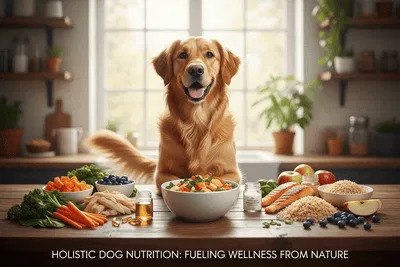
Diversity is the hallmark of a resilient microbiome. In the wild, a dog's ancestors would eat a variety of proteins: rabbit one day, deer the next, maybe a few berries or some grass. In modern holistic dog wellness, we’ve moved toward "monoprotein" diets for convenience, but this can actually lead to a stagnant gut.
The Resilience Hack: Rotational Feeding Introducing diverse, high-quality proteins (think turkey, beef, duck, or fish) provides different amino acid profiles and encourages a wider variety of beneficial bacteria to take up residence. This "microbial richness" is a primary pillar of canine functional medicine.
- Note: If your dog has a sensitive stomach, always transition slowly. We’re building a fortress, not a fireworks display.
Precision Postbiotics: The New Frontier of Resilience
You’ve heard of probiotics (the bugs) and prebiotics (the food for the bugs). But the real "magic" happens with postbiotics.
Postbiotics are the beneficial "waste products" created when your dog’s gut bacteria ferment fiber. The most famous one is Butyrate, a short-chain fatty acid.
Why should you care about Butyrate?
- It feeds the cells lining the colon, keeping the "border" strong.
- It has direct anti-inflammatory effects.
- It helps "program" the immune system to recognize what is a threat and what is a friend.
Instead of just tossing any old probiotic at your dog, we are moving toward precision postbiotics: supplements or dietary strategies that specifically increase these health-giving metabolites. Adding things like steamed broccoli, mushrooms (like those found in our Mushroom Immune Gold), and specific fermentable fibers can turn your dog's gut into a postbiotic factory.
The Toxin Audit: Protecting the Border
We can't talk about gut health without talking about what's trying to break in. Modern dogs are bombarded with environmental toxins: pesticides on the lawn, flame retardants in their beds, and chemicals in their water. These toxins don't just sit there; they irritate the gut lining and kill off beneficial bacteria.
We recommend a "Toxin Audit" for your home:
- Filter the Water: Chlorine can be tough on the microbiome.
- Ditch the "Fragrance": Scented candles and plug-ins are often endocrine disruptors.
- Support the Liver: If the gut is the border, the liver is the filtration plant. Our Detox Gold is designed to help your dog process and eliminate these "uninvited guests" safely.

Your "Gut-Immune" Action Plan
Building a resilient dog isn't about one "miracle" supplement; it’s about a lifestyle of empathetic partnership with your dog’s biology. Here is our recommended protocol:
- Feed for Diversity: If your vet agrees, rotate your protein sources every few months. Add "real food" toppers like blueberries, steamed kale, or sardines.
- Fiber is Your Friend: Prebiotic fibers (like chicory root or pumpkin) are the "fuel" for those postbiotic factories.
- Targeted Supplementation: Use evidence-based tools. If you're worried about early detection, consider the Oncotect Cancer Test to get a baseline of your dog's health.
- Track the Journey: Gut health can be subtle. Use a Quality of Life Tracker to monitor your dog's energy, stool quality, and overall "sparkle."
Driven by Hope, Guided by Science
We know that a cancer diagnosis (or even the fear of one) is one of the heaviest weights a pet parent can carry. It’s scary, it’s confusing, and the internet is full of "cures" that offer nothing but false hope.
We aren't here to give you false hope. We’re here to give you real help.
By focusing on the Gut-Immune Axis, you aren't just "treating a symptom": you are honoring the bond you share with your dog by supporting their body’s most fundamental defense system. Whether you are navigating a diagnosis or just trying to keep your healthy dog thriving for as long as possible, we’re here for you.
You’ve got this. And we’ve got you.
References
Chun JL, Ji SY, Lee SD, Lee YK, Kim B, Kim KH. Difference of gut microbiota composition based on the body condition scores in dogs. J Anim Sci Technol. 2020 Mar;62(2):239-246. doi: 10.5187/jast.2020.62.2.239. Epub 2020 Mar 31. PMID: 32292931; PMCID: PMC7142278.
Kim H, Chae Y, Cho JH, Song M, Kwak J, Doo H, Choi Y, Kang J, Yang H, Lee S, Keum GB, Wattanaphansak S, Kim S, Kim HB. Understanding the diversity and roles of the canine gut microbiome. J Anim Sci Biotechnol. 2025 Jul 5;16(1):95. doi: 10.1186/s40104-025-01235-4. PMID: 40615864; PMCID: PMC12228404.
Huang Z, Pan Z, Yang R, Bi Y, Xiong X. The canine gastrointestinal microbiota: early studies and research frontiers. Gut Microbes. 2020 Jul 3;11(4):635-654. doi: 10.1080/19490976.2019.1704142. Epub 2020 Jan 28. PMID: 31992112; PMCID: PMC7524387.
Rindels JE, Loman BR. Gut microbiome - the key to our pets' health and happiness? Anim Front. 2024 Jun 20;14(3):46-53. doi: 10.1093/af/vfae015. PMID: 38910954; PMCID: PMC11188957.
Reviewed by: Amber L. Drake, PhD
Dr. Amber L. Drake is a board-certified holistic health practitioner, canine clinical herbalist, educator, and founder of the Drake Dog Cancer Foundation and Drake Dog Academy. She is dedicated to helping pet parents better understand canine cancer, treatment options, nutrition, quality of life, and supportive care through compassionate, evidence-informed education. Her work combines professional training, practical resources, and firsthand insight from supporting thousands of dog families through the challenges of a cancer diagnosis.
Stay connected with news and updates!
Join our mailing list to receive the latest news and updates from our team.
Don't worry, your information will not be shared.
We hate SPAM. We will never sell your information, for any reason.